Tuesday, May 31, 2011

Regional restrictions of digital content - or - "that's a really dumb idea"

Credit: US Geological Survey
If you live outside of the US, you'll probably be familiar with this scenario.

Your favourite artist or author releases something new. They dutifully link you to the Kindle edition or iTunes  store. You happily log on, your credit card twitching in your eager paw and...
This item is not available in your county.
Curses! Foiled again.

You now have to order the physical item, pay an additional delivery and customs fee, and risk losing said item in the post (and let's not mention all the times it has taken months to receive an item that should have taken two weeks). Of course, my guess is that most people these days are now resorting to piracy or circumventing the restrictions through shadier means (spoofing IP addresses, faking physical addresses, paypal is probably involved at some point too).

My response to that... is pooh!

It's a digital age. There's no logical reason for digital content suppliers to use geography as an excuse to deny sales.

Oh, I'm sure the big publishers and suppliers have reasons. Contracts -  no doubt written sometime during the Seventies - sitting in their drawers, highlighting the whys and what-the-hecks of denying half the globe the same instant, affordable content that the big countries are allowed. But, gosh darn it, I have a Kindle and I have an iPod and I want to fill it with my favourite things.

Indie authors get it. I have yet to find an indie book that wasn't available in my region, or one that is as highly priced as some of the big authors ($16 for the Kindle format of a backlisted book - I think not publishers!). For this reason, my mainstream author purchases are now primarily at second hand stores (which probably doesn't profit the publisher or author) and indie books are getting a permanent chunk of my monthly budget.

Why don't the big publishers cotton on to this fact? Why can't music executives? Television and movie distributors?

You see the pattern?

The very people who would profit the most from global content distribution are the ones building digital borders. These same people are also spending millions on combating piracy, when they already have the means to reduce it.

People aren't generally nefarious pirates by nature. Our natures are to want things quickly, easily and within the confines of our stretched bank balances.

Sunday, May 29, 2011

GUEST POST: How to Help Your Favorite Authors - by Lindsay Buroker

Originally by Lindsay Buroker, author of Flash Gold, The Emperor's Edge, and Encrypted. Finally giving me an answer to one of the questions I've been dying to ask an Indie author.
As authors, we spend a lot of time trying to promote our books. Our biggest obstacle is obscurity because there are a lot of books out there. No, really. A lot.
We like to think that good stories are all it takes to make it (in author terms “make it” usually means “become well known enough and sell enough books that I can quit my day job and write for a living”), but you can doubtlessly think of mediocre books that are selling bazillions of copies and authors you love who never make it out of the “mid-list” category.
Sometimes it’s just the author (or publishing house) with the biggest marketing budget who wins, but you, as a reader, have amazing power. Don’t believe for a second that you don’t have anything to do with whether an author makes it, because you do. A lot. No, really. A lot.
Why does this matter to you? Well, authors who get to quit their day jobs can write faster and put more books out for you!
The following are some little things you can do that can make a big difference. Some of them only take a few seconds. Your favorite authors will appreciate the effort. Trust me. 
Helping out on Amazon
Amazon is the big kahuna of book sellers, especially when it comes to ebooks, so helping an author “get found” on there can give them a big boost. You can certainly do these things on other bookstore sites as well (nothing against copying and pasting a review, for example), but Amazon tends to have more cool features to help an author get found.
Here’s the list (any one of these things can help):
  • If you do nothing else, consider writing a review on Amazon, even if the book already has quite a few and/or you’ve reviewed it elsewhere. There’s evidence that ratings and reviews factor into the Amazon algorithms that decide which books are promoted on the site (i.e. certain books are recommended to customers who bought books in similar genres). If reviewing isn’t your bag, don’t worry about writing paragraphs-long in-depth studies of the book; maybe you could just pen a few sentences with a couple of specifics about why you liked the book.
  • “Tag” the book with genre-appropriate labels (i.e. thriller, steampunk, paranormal romance). You don’t have to leave a review to do this; you just need an account at Amazon. A combination of the right tags and a good sales ranking can make a book come up when customers search for that type of story on Amazon.
  • Give the book a thumb’s up. This takes less than a second and probably doesn’t do much, but it may play into Amazon’s algorithms to a lesser extent than reviews/ratings.
  • Make a “Listmania” List and add your favorite authors’ books to it. This creates another avenue for new readers to find books. It’s better to create lists around similar types of books (i.e. genres or sub-genres) than to do a smorgasbord, and consider titling it something description so folks will be more inclined to check it out, ie. “Fun heroic fantasy ebooks for $5 or less”
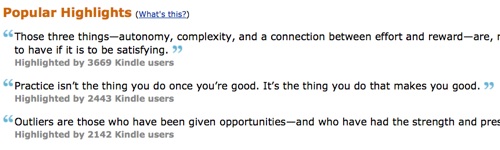
  • If you have a Kindle, highlight some wise or fun quotations from the book and share them publicly (if enough people share their highlights, they’ll show up at the bottom of a book’s page):
Popular Highlights on a Book's Sales Page
Helping out with Social Media
If you’re involved with Twitter, Facebook, Digg, StumbleUpon, etc., you can give your favorite authors a shout-out when they release new books. If they blog, you can follow their site (through Google Reader or other RSS readers) and share the link when they post something that may be interesting to your friends. If they’re on Twitter, you can follow them and retweet their links now and then.
Authors don’t expect you to follow them 24/7 and repeat everything they say (that might actually alarm some folks…), but a little promotional help now and then is greatly appreciated.
If you like to be social about books, you can join sites such as Goodreads, Shelfari, or LibraryThing. You can help your favorite authors by posting reviews and talking about their books on those sites, or you can just use those places to find online reading buddies with common interests.
Helping out with Your Blog
Do you ever talk about books or what you’re reading on your blog? You might consider reviewing your favorite authors on your site (you could even make a few dollars if you signed up as an Amazon affiliate).
Also, if most of your favorites maintain websites, you could add an “author blogroll” list in your menu with links to those sites.
And Lastly…
These days, most authors have websites and contact forms so you can get in touch. If you enjoyed their work, consider sending them a short note to let them know. While it won’t help them sell more books, it’ll make their day.
Thanks for reading (this post and books in general!).

Wednesday, April 27, 2011

The rise of indie books (in my budget) - exciting times for readers

I've always been a judge a book by its [cover/title/author] kind of gal. I walk into a book store and grab the first book I see with an attention-grabbing title, fantastic looking cover or emblazoned with one of the names from my known, dependable set of authors.

I've tried reading web fiction, but as awesome as some as it is - and believe me, there are a slew of amazing, talented writers on the web - I have no patience for reading online. I like to curl up on a couch and forget those floating bytes and bits that distract me on a daily basis.

In November 2010, I was given a Kindle.

By April 2011, the way I view books had changed dramatically.

In the beginning, I stayed with the big guys: George R. R Martin, Brandon Sanderson, Nail Gaimon... but eventually I noticed two things: one, many traditionally published authors were unavailable on the Kindle for my region (regional restrictions in a digital age - really?), and two, a majority of the books recommended to me by Amazon were a fraction of the price of the big guys.

I'm not saying price is the only factor in my decision to start buying more and more indie authors, though it certainly doesn't deter the cash-challenged. It's just sheer fun discovering new authors that don't make it to my mainstream book stores.  It's also a heck of a lot easier to find recommended new reads if you start moving in the indie circles too.

Don't believe me?

Purchasing my first Indie book, Susan Bischoff's Hush Money, a YA superhero novella, led me to try Kait Nolan's Forsaken by Shadow, which somehow led me to Amanda Hocking and Vicki Keire, which led me to JL Bryan, which led me to... you get the picture. (By the by, I do recommend that you try the samples from each of the above authors.)

The best part - every day there is a new discovery. Indie authors seem to be able to find the best of each other and pay this forward to us, the readers and willing slaves to awesomeness. I have so many samples of books I want to buy that I wonder how I'll ever read it all. In the first few months of 2011, I've doubled my annual amount of reading and book purchases.

There is a down-side, of course. Some books that have been released into the wilds were let go too early. I've purchased at least one book that became downright unreadable because of poor formatting and editing, and another book that could have benefited from some tightening of the plot and characterisation. But all in all, I've had some great luck in the indies I've read.

My strategy is not terribly complex or original:

  • Read recommendations from people whose opinion you value, for example, all of the authors linked to above also have goodreads accounts; it's a good way to keep your finger on the indie pulse in your favourite genres.
  • Download and read the kindle samples first - don't skip this part unless you really, really trust your recommender.
  • Follow indie authorities like the Indie Book Collective - also on twitter.
  • Keep track of the Amazon and Goodreads ratings - I don't read the nitty gritty of each review because of spoilers, but I try and stick to books that average above 3.5 stars.
  • Judge the book by its cover - well, this one is a more personal choice, but I've found that the books that have professional-looking covers are also more likely to have been well-edited on the inside too. I could be proven wrong in this point at any time, but I'll stick with it until I am.
  • Finally, if you've loved an indie book, say so! I've actually realised that I need to read a book twice before I can review it properly with my current methods, so while I figure out a better, faster way to spread the love, I do try and tweet/blog my book/author recs whenever I can. If you want to see some gorgeous covers, check out Phatpuppy Creations.
Up next: questions I want to ask indie authors.

Cover art belongs to their respective rights holders. For more details on either of these books, please see post for links.

Sunday, April 3, 2011

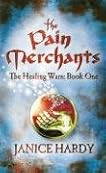
Review: The Healing Wars 01. The Pain Merchants

The Healing Wars 01. The Pain MerchantsThe Healing Wars 01. The Pain Merchants by Janice Hardy

My rating: 5 of 5 stars


Browsing through a packed table of sale books, my eye immediately landed on two words: Pain Merchants. As far as titles go, it's a great one to immediately classify genre and get a fantasy reader like me to grab it without reading the blurb. I wonder if I would have reacted the same way had I had read "The Shifter" on the spine instead. It's a moot question now. I saw. I grabbed. I enjoyed immensely.

The Pain Merchants is a first person tale from the point of view of Nya, an orphaned teenage girl with an extraordinary ability. Nya, of course, doesn't see this ability as particularly good. She is an anomaly in a world with a intriguing system of magic.

The world's magic system is centred on healing. Healers heal wounds and take the pain into themselves. They then transfer the pain into a stone called Pyruvium. This stone is then enchanted to inflict the pain on others during battle. It's a fairly neat symmetrical system, but of course, some chap has to spin that cycle to his own advantage.

Enter the unseen, but presumably nasty Duke. He's been invading and subduing other nations for his own nefarious purpose. I wonder if his title means that there is an unspoken and equally cruel King - the Duke is attacking these nations for *some* reason.

Nya's nation of Gevegian has been crippled by the war, and is now run by the Duke's own Baseeri. Healers and enchanters alike were taken and killed or died fighting. It is for this reason that Nya and her sister were tossed out onto the street to fend for themselves, despite coming from an aristocratic family of healers.

Nya's sister, Tali, is a healer and has been able to find purpose in the League of Healers. Nya can also heal, but she can't safely release the pain into a stone. She can only shift it into other people. She keeps this unusual ability a secret, but someone inevitably finds out. When the city has more pain than rocks or healers, this becomes a huge commodity to those same people.

While Nya has kept her ability a secret for her entire life, it doesn't mean that she is a fearful or morose character, like some characters in similar situations have been. Once her mind is made up, she will face insane odds to protect the ones she loves and those she feels responsible for. It's an admirable trait, and one I suspect is also a forgotten trait of the Gevegians themselves. Her friends and family certainly display this incredible bravery when pushed.

This book sets up a world that is a literal powder-keg with a character that can ignite it in strangely unexpected ways. I look forward to however this war may explode.


View all my reviews

Tuesday, March 29, 2011

The Company... not your average read

see disclaimer below
I've been quiet on the book review front lately for one simple reason: scripted web fiction.

You all know what web fiction is, and a fair smidgeon of you know what a script is, so of course, I've spent the past couple of weeks reading a total of 24 original web-only teleplays.

I'll go into more detail about scripts and scripted fiction at a later date, but here are the bare facts you need to know.

The Company, created by Sarah-Jane Sheppard, simply... rocks.

Do you love Pushing Daisies, Wonderfalls or Dead Like Me? Because that's the kind of quirky, offbeat awesomeness you can expect to encounter in this young adult dramedy.

Meet Vi Morgan, a 16-year-old high school student. One day she's dead. And the next day, she kinda isn't. But her resurrection does come with an interesting price tag: she has to work for "The Company" and keep her secret life, well, secret from her family and friends. You can imagine how well that turns out.

Helping her out, is her scruffy, rebellious, but generally well-meaning mentor, Andrew, the efficient, but damaged, Jenna, and her best friend, the lovable, clumsy, musician-wannabe, Shane. Helping her keep on her toes is her nerdy, but adorkable, brother Cam, her neurotic, writer father, her commanding, but well-meaning mother and her bit-of-a-bitca sister, Penny.

Season one is a mere 13 episodes long, while season two rockets up to a full 22-episode roster. These numbers may seem daunting, but teleplays are a lot faster to read than novels, so it's quite doable to load up your Kindle and nail these beauties in under a week or two. And with Sarah-Jane's seemingly effortless ability to craft easy-to-read scripts, just overflowing with juicy dialogue, addictive character interactions and the occasional serial killer or two, it might even take you faster than that.

And believe me, you'll want to. Season 3 is coming soon!

Read The Company at:

Disclaimer: scripted web series will often use established actors to visually represent fictional characters. These actors are in no way affiliated with the series and are merely used as physical avatars. In fact, quite often, I replace characters with my own favoured actors (just like you'd do when reading novels).